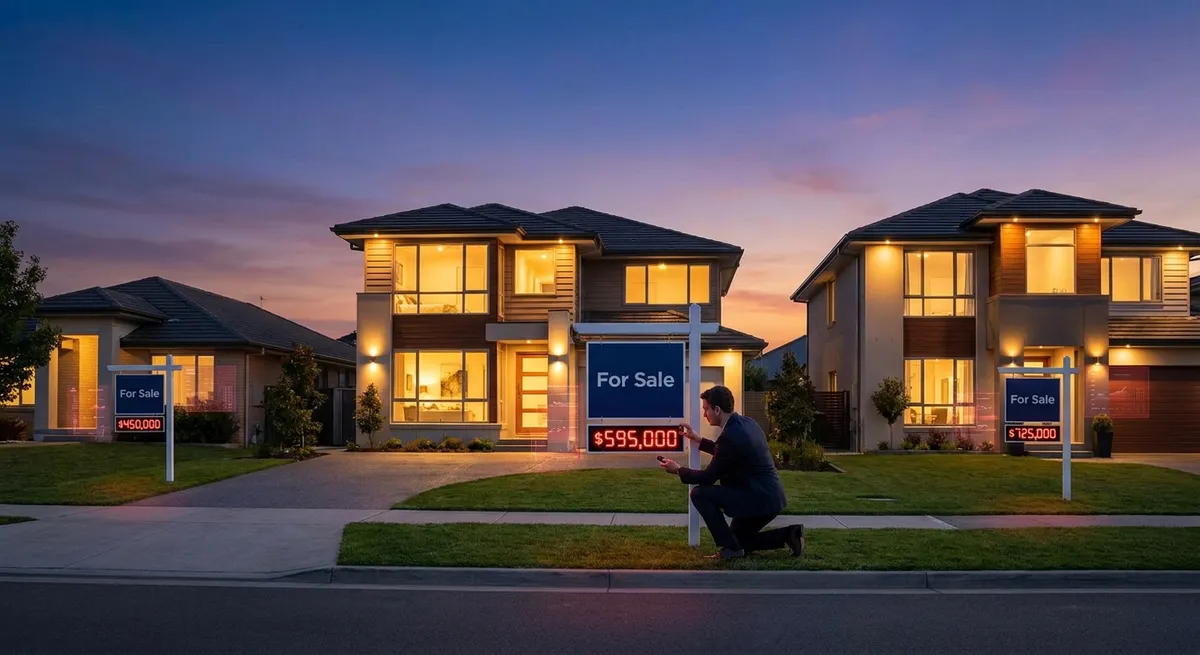
This guide breaks down five strategic pricing moves designed to help your listing stand out, attract serious buyers quickly, and convert interest into a solid contract without leaving money on the table.
Strategy 1: Anchor Against the Competition, Not Just the Comps
Most sellers and even many agents start with a basic comparative market analysis (CMA). Useful—but incomplete if you want speed. Fast sales come from understanding how buyers compare your home to everything else they’re seeing this week, not what sold months ago in a different market mood.
Look beyond recently sold properties and study active competition: similar homes buyers can choose today. Analyze list price, days on market, photos, condition, and any recent price cuts. Your goal is to place your property where it looks like the best decision, not just a fair one. If three comparable homes are all listed at $495K–$505K and sitting, positioning your home at $489K with better presentation doesn’t just undercut them—you anchor buyer perception that your property is the “smart buy” in that cluster.
This is pricing as positioning, not as math. Buyers operate in relative value: “This one vs that one.” Your price should be chosen relative to what they’re clicking on, touring, and seeing in person—not just what their agent shows them from last quarter’s sales.
Strategy 2: Use Data Bands, Not Gut Feel, to Set Your List Price
Buyers don’t search by your opinion of value—they search by price bands and filters on Zillow, Redfin, and agent portals. If your list price misses a critical search band, you can quietly lose a chunk of your ideal buyers from day one.
Identify the key search brackets in your area. For example, if buyers commonly search $350K–$400K and $400K–$450K, a price of $405K could bury you in the higher band, while $399K gets you seen by everyone in the lower band and looks like a deal compared to $410K+ listings. This isn’t about “charm pricing” alone (like $399,900); it’s about aligning with how buyers filter what they see on their screens.
Back this up with data from your agent’s MLS tools: see how many buyers’ saved searches, auto-emails, or portal activity sit in each price range. Choose a price that hits the highest volume buyer band while still protecting your net. You’re solving for maximum eyeballs in week one, not maximum ego in the asking price.
Strategy 3: Pre-Plan Your Price Adjustments Before You List
Price reductions done late and out of desperation send a signal: “Stale, maybe negotiable, probably something wrong.” To sell quickly and cleanly, treat pricing as a pre-planned campaign, not a one-time decision.
Before you go live, establish:
- A clear day-on-market threshold for action (e.g., 10–14 days with low showings, or 20–25 days with good showings but no serious offers).
- A pre-approved reduction ladder, such as a 2–3% first reduction, followed by a sharper move if needed.
- Measurable triggers: number of showings, saves, open house traffic, and feedback themes (e.g., “priced too high” from multiple buyers/agents).
Once you’re live, you simply execute the plan instead of debating emotions. This shows the market you’re a serious seller and keeps your listing from drifting into “why has this been listed for so long?” territory. Fast, decisive moves preserve leverage—waiting and hoping usually just feeds lowball offers.
Strategy 4: Price the House You’re Actually Selling, Not the One in Your Head
Many sellers price based on what their home used to be (before deferred maintenance) or what they meant to do (“once I update the kitchen, it’s worth more”). Buyers pay for what they see, not what you remember—or plan.
Walk through your property as if you’re a buyer touring three homes in one afternoon:
- Does your home feel move-in ready, mildly dated, or project-heavy?
- How does it stack up on fixtures, flooring, windows, roof, systems (HVAC, electrical, plumbing) compared to competing listings?
- Are there obvious inspection red flags (older roof, aging furnace, signs of moisture, old electrical panels)?
Then price for the true, present-tense condition—and decide whether to adjust price or fix issues. If you won’t invest in updates or repairs, your price must account for the buyer’s risk, hassle, and uncertainty. That doesn’t always mean a huge discount, but it does mean acknowledging reality.
You can also build this into your pricing narrative: “As-is price reflects older roof and original kitchen” signals transparency and can actually attract investors and practical buyers looking for value and upside. Clarity plus realism beats wishful thinking every time when speed matters.
Strategy 5: Use Strategic Underpricing Only When You Control the Narrative
Strategic underpricing—listing slightly below market to spark a feeding frenzy—can work in hot micro-markets. It can also backfire if executed without control and context. The key is intentionality and tight campaign design.
An effective underpricing play requires:
- Strong evidence of pent-up demand (low inventory, multiple-offer norms, fast median DOM in your segment).
- A price just low enough to feel like an opportunity, not a red flag (e.g., 3–5% below realistic value, not 15%).
- An intentional timeline: list midweek, heavy push into the weekend, limited showing windows, and a clear offer deadline (e.g., “All offers due by Monday at 5 PM”).
- Clear agent communication that the seller expects competitive bids and will review all offers together.
This accelerates activity, concentrates serious buyers in a short window, and can produce not just higher price but cleaner terms (fewer contingencies, stronger earnest money, better timelines).
However, if your local data shows sluggish showings, price-sensitive buyers, or high days on market, underpricing may just lock in a low number with no bidding war. In those conditions, a sharper, realistic price with strong presentation and a firm response strategy to the first solid offer is often the smarter move.
Conclusion
Fast, effective real estate sales don’t happen because a seller “got lucky.” They happen because someone treated price as a deliberate strategy—aligned with buyer behavior, local data, property condition, and competitive positioning.
If you want speed and a strong net, you can’t afford casual pricing. Study the competition, hit the right search bands, pre-plan your adjustments, price the actual condition of your home, and only deploy underpricing when the market conditions and campaign structure support it.
Combine these five strategies with professional photos, tight listing copy, and a disciplined response plan to early offers, and you’ll dramatically increase your odds of moving from “Just Listed” to “Closed” in less time—and with less stress—than most sellers in your market.
Sources
- U.S. Federal Reserve – “How Does Housing Wealth Affect Consumption?” - Research context on how housing values and pricing dynamics impact behavior
- National Association of REALTORS – Existing-Home Sales Data - Up-to-date stats on sales, prices, and days on market across the U.S.
- Zillow Research – Housing Market Reports - Data on price bands, inventory, and buyer activity by market
- Redfin Data Center - Competitive market data including median days on market, bidding war frequency, and pricing trends
- U.S. Department of Housing and Urban Development (HUD) - Official housing market conditions reports and analysis