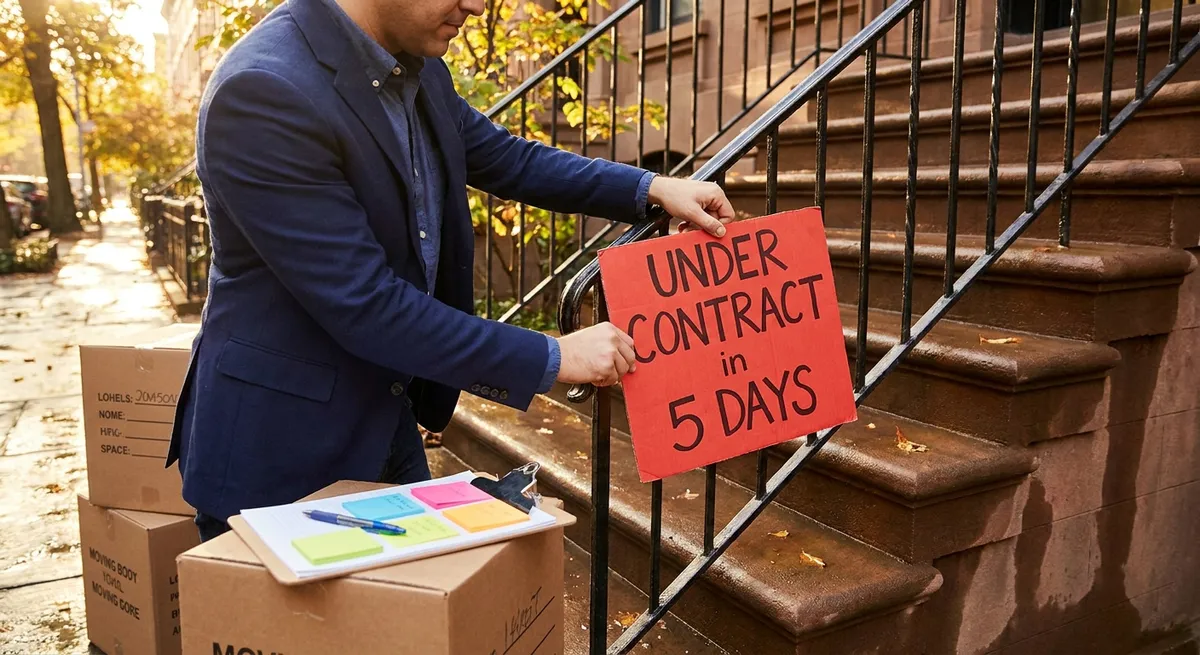
This playbook breaks down five high-leverage strategies to sell faster and more effectively—without defaulting to massive price cuts.
Strategy 1: Engineer a Frictionless First Impression
Most “slow” listings lose momentum in the first 72 hours. Buyers see a property, mentally file it as “work” or “uncertain,” and move on. Your job is to engineer a first impression that feels clean, simple, and safe to act on quickly.
Start by eliminating visible objections: deep-clean, declutter, and neutralize. Remove anything that makes rooms feel smaller (oversized furniture, busy rugs, heavy drapes). Think of your home as a product on a shelf—buyers need to instantly understand its value without decoding your personal style.
Next, tighten up the “decision anchors” buyers subconsciously use: fresh caulk in bathrooms, clean grout, working lightbulbs in all fixtures, well-trimmed landscaping, no peeling paint, tidy entryway. These details signal “well maintained,” which compresses decision time.
Finally, clarify your positioning before you list. Decide: are you selling as “best condition in this price point” or “strong value with room to customize”? Everything—from your photos to your description to your showing preparation—should reinforce that single, clear message. Ambiguity slows buyers down; clarity speeds them up.
Strategy 2: Deploy “Fast-Track” Pricing Without Leaving Money on the Table
Selling quickly does not always mean pricing low. It means pricing strategically so your home is unmistakably competitive within its micro-market.
Start with data, not emotion. Pull sold comparable properties from the last 60–90 days that match your property on location, size, condition, and style. Ignore active listings—they show you competition, not reality. Anchor your thinking to closed prices, then adjust for differences in features and upgrades.
Use a narrow price band and target the “search bracket” advantage. For example, if data supports $505K–$515K, consider $499K or $509K based on common buyer search filters in your area. Your goal is to appear in as many saved searches as possible while still signaling legitimate value.
Then, set clear pricing rules before you hit the market:
- A specific review date for adjusting price if showings and inquiries are sluggish
- Trigger thresholds (e.g., “If we get strong traffic but no offers in 10 days, we adjust” vs. “If we get few showings at all, we reduce more aggressively”)
This turns pricing from emotional reaction into pre-planned strategy—and lets you move quickly when data tells you to.
Strategy 3: Turn Your Listing Into a High-Performance Marketing Asset
Your listing is not a flyer; it’s a campaign. The goal isn’t just exposure—it’s targeted, high-intent exposure that converts to showings and offers.
Start with visuals that outperform the competition. Use a professional photographer who understands real estate (not just portraits). Insist on:
- Wide, bright shots that show full rooms and natural flow
- A clean, logical photo order: exterior → entry → main living areas → kitchen → bedrooms → baths → yard
- A few “hero” images that will be used as the main thumbnail on all platforms
Pair visuals with a results-oriented description. Avoid generic filler like “must-see” or “won’t last.” Instead, highlight:
- Time-saving features (turnkey upgrades, low-maintenance yard, nearby transit or commute routes)
- Cost-saving features (energy-efficient systems, newer roof/HVAC, low HOA, favorable taxes)
- Speed-friendly benefits (ready for quick close, flexible move-out timing, recent inspection on file)
Then, amplify your listing where serious buyers live online: MLS, major portals, and targeted social media. Use short, punchy hooks in social captions (“No-renovation-needed 3-bed near [Major Employer] with fast-close option”) and always include clear calls to action: schedule a showing, request disclosures, or ask about closing timelines.
Strategy 4: Reduce Buyer Risk Before It Kills Your Momentum
Slow deals often stall because buyers feel exposed—too many unknowns, too long to wait for answers, too many potential “surprises.” You can flip that dynamic by pre-solving their biggest fears.
Start with pre-listing intelligence:
- Get a pre-listing home inspection from a reputable inspector
- Pull permits and documentation for major work
- Collect utility costs, HOA docs, and any warranties (roof, appliances, structural, systems)
Instead of hoping issues don’t surface, control the narrative. If the inspection reveals something meaningful, either fix it before listing or disclose it clearly with a plan (e.g., estimate on hand, credit at closing, or contractor ready to perform work). Buyers move faster when they understand the “true condition” upfront.
Next, streamline your response infrastructure. Decide in advance:
- Who answers showing requests and how fast (aim for same-hour responses during the day)
- Who handles questions about disclosures, property lines, and systems
- How you’ll deliver information (pre-made PDF info packet, digital document folder, or agent-driven portal)
The more you de-risk the purchase and shorten the time between “interest” and “confidence,” the faster buyers will write serious offers.
Strategy 5: Control Urgency With Structured Showings and Smart Offer Timing
A quick sale is often more about how you manage attention than how “amazing” the property is. Your goal is to create controlled urgency—buyers should feel they’re competing for a scarce opportunity, not leisurely evaluating an endless option.
Start by organizing showings intentionally:
- Concentrate first-wave showings within a tight window (for example, a strong launch weekend with back-to-back slots)
- Limit overly long appointment windows so buyers see cars coming and going—social proof builds urgency
- Make sure every showing experience is consistent: lights on, blinds open, climate comfortable, printed info sheets available
Next, set and communicate a clear offer plan from day one:
- “We will review offers on [specific date/time], but reserve the right to accept a standout offer earlier.”
- Ask your agent (or yourself, if selling by owner) to relay activity-level updates to interested buyers’ agents: “We currently have X showings booked and Y parties requesting disclosures.”
When an offer comes in early, use it strategically. Let other interested parties know you’ve received an offer and set a firm deadline for all submissions. This can convert casual interest into action and compress the time to a strong contract.
Throughout, focus on terms—not just price—that support speed: higher earnest money, shorter inspection contingency, proof of funds or full pre-approval, and a closing timeline aligned with your move-out needs. A slightly lower offer with clean, fast terms is often more valuable than a top-dollar offer that drags out your exit.
Conclusion
A fast sale is not a mystery outcome—it’s the result of disciplined execution across five fronts: first impressions, pricing, marketing, risk reduction, and urgency control. When you treat your property like a product launch instead of a passive listing, you attract more serious buyers, compress decision timelines, and keep leverage on your side.
Use these strategies as a checklist before you hit the market. The more thoroughly you prepare and the more tightly you manage buyer experience from the first click to the final signature, the faster you’ll move from “for sale” to “successfully closed.”
Sources
- U.S. Census Bureau – Characteristics of Recent Movers – Data on housing mobility and buyer behavior trends
- National Association of Realtors – 2024 Home Buyers and Sellers Generational Trends Report – Insight into how different buyers search and decide, useful for targeting your listing
- Federal Trade Commission – Selling a Home – Official guidance on disclosures, representation, and consumer protections
- U.S. Department of Energy – Energy Saver – Information to verify and communicate efficiency upgrades that can boost perceived value
- Harvard Joint Center for Housing Studies – Housing Market Research – Macro-level research that helps contextualize timing and demand in local markets